Home

GREMLIN - GReen Energy Monitoring for Large INfrastructure
A non-intrusive, facility-scale diagnostic layer that turns the electromagnetic noise every electrical device emits into actionable information — where energy is used, and which equipment is degrading — from a few high-bandwidth measurement points instead of per-device instrumentation.
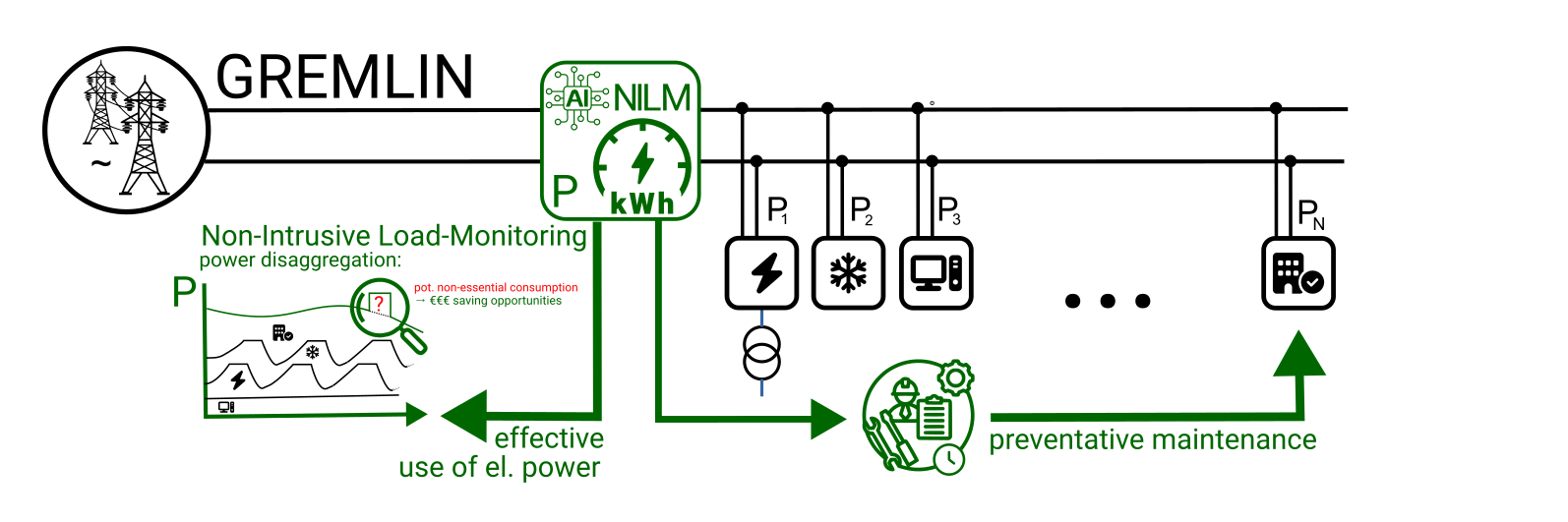
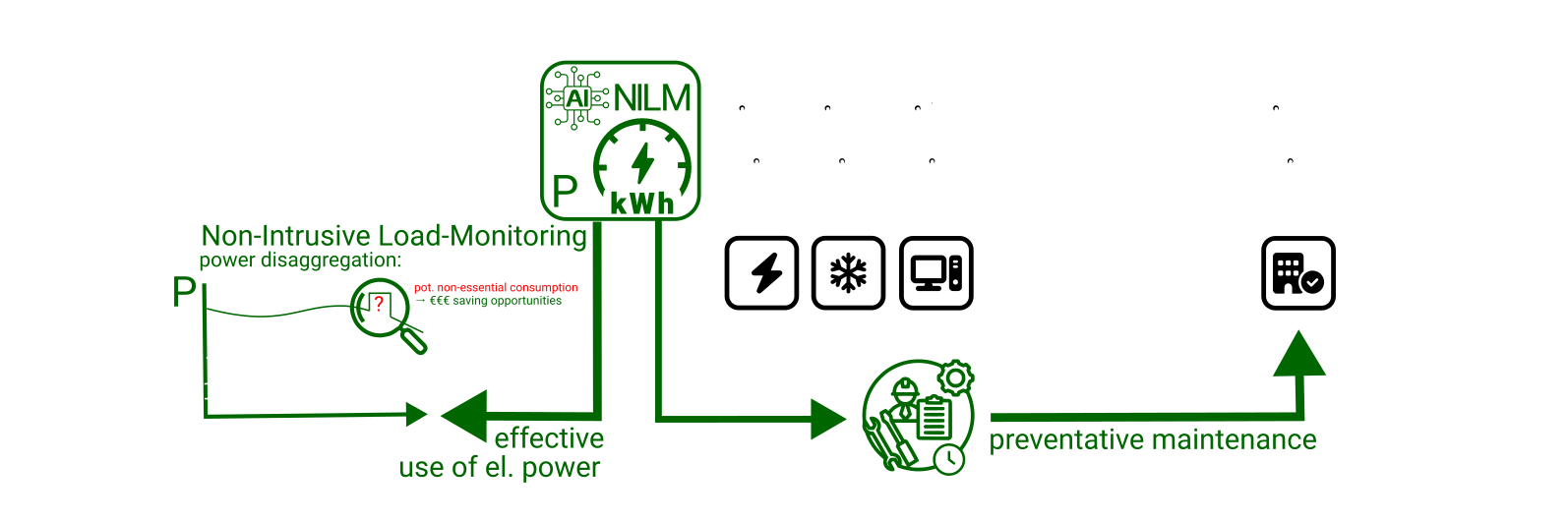
From that one measurement, GREMLIN produces two operational outputs: a disaggregated, per-device picture of where the energy goes
(the footprint axis), and an early-warning layer that detects the slow drift of EMI signatures as equipment ages
(the availability axis). Signal processing runs on GNU Radio 4.0 — already used operationally at GSI/FAIR
— and machine-learning models are deployed through the framework-neutral ONNX exchange format. Models are benchmarked against
well-understood classical spectral estimators, so any claimed gain is measured against a transparent baseline rather than asserted.
As a by-product, GREMLIN also surfaces unaccounted-for loads — power drawn on the network that matches no known device signature.
It builds directly on the published GSI proof-of-concept pulsed-power-ml
and matures that work toward larger device counts under iRIS.
Status — research → engineering. An engineered model is validated today at small scale (order tens of devices); iRIS funds maturing it toward TRL 6–7 at larger device counts, under real-world conditions.
GREMLIN is a diagnostic layer, not an energy controller: it identifies where action is warranted; operators and existing control systems decide and act.
Further reading:
- How it works — EMI signatures, disaggregation, NILM, and the classical-baseline benchmark.
- What it provides — energy footprint, availability, unaccounted-for loads, and grid compliance.
- References — prior art, related projects, and citation.
Ecosystem & Reproducibility
GREMLIN is developed as free / open hardware and software at GSI/FAIR; reproducibility is an explicit project goal. It builds on the FAIR-ACC open stack, with models exchanged in the portable ONNX format.
| Repository | Purpose |
|---|---|
| gremlin (this repo) | Documentation, models, demonstrations |
| pulsed-power-ml | Pulsed-power PoC and electrical-network-compliance work |
| gnuradio4 | GNU Radio 4 signal-processing runtime (GR4) |
| gr-digitizers | DAQ / digitiser integration |
| opendigitizer | UI / UX |
Related technologies: GNU Radio, ONNX, VictoriaMetrics (time-series DB, tbc).
License and Copyright
Unless otherwise noted:
SPDX-License-Identifier: LGPL-3.0-or-later WITH LGPL-3.0-linking-exception &
SPDX-License-Identifier: CC-BY-SA-4.0
Copyright © GSI Helmholtz Centre for Heavy Ion Research, Darmstadt, Germany
Copyright © FAIR — Facility for Antiproton and Ion Research in Europe, Darmstadt, Germany
Funding & Acknowledgements

|
This project has received funding from the European Union's Horizon
Europe research and innovation programme under grant agreement
No. 101275935 (iRIS – Intelligent Research Infrastructure Sustainability). Views and opinions expressed are however those of the author(s) only and do not necessarily reflect those of the European Union or the granting authority. Neither the European Union nor the granting authority can be held responsible for them. |
GREMLIN is developed at GSI and FAIR, Darmstadt, with contributions from iRIS partners. It builds on the
GNU Radio 4.0 streaming signal-processing framework and reuses domain knowledge from
fair-acc/pulsed-power-ml.